Sunday, June 4, 2023

Espana Tour: Aves y Natura en Espana (or, Birds and Nature in Spain...but sounds so much better in Spanish, doesn't it?) - and click on photos for full/bigger images!

The landscapes in Asturias aren't just spectacular for biking and hiking and vistas; they also provide habitat for an astonishingly diverse range of birds and insects, due to the close proximity of a variety of habitat types.  According to SEO Birdlife (Sociedad Espanola de Ornitologia - website translation available if you click in the webpage address bar at top of page), 2022 data indicates that Spain is home to over 600 species of birds, while Asturias may have upwards of 400 species within the region.  There are both residents and migrants, and all depend on a robust array of insects, wildflowers, high mountains, forests, meadows, wetlands/estuaries, rivers, and ocean ecosystems that are part of those beautiful Spanish views.  In our travels, we have stopped over and over - whether walking, biking, hiking - to simply listen to the orchestra of birdsong around us. It starts before dawn, and ends late in the evening, along with chirps of insects and frogs. We are learning to hear individual songs as well, and delight in the mellifluous tones of the Eurasian wrens, robins, and warblers of various kinds. Some common Asturian sightings are listed here. Wikipedia provides a much more extensive list, for those of you who are bird enthusiasts.

Eurasian Robin - one of the most lyrical songbirds we've heard over here!

As is the case across the globe, bird populations in Spain are plummeting, along with species diversity. Intensive farming using pesticides and fertilizers is a huge culprit (The Guardian, May 2023).  But also loss of habitat - for example, conversion of diverse forested lands to government-subsidized monocultures of eucalyptus, or cattle-grazing meadows (you don't get windfall payments/subsidies from the Spanish government for a few cattle).  And hunting, too.  Spaniards like to shoot - though some signs that there may be small steps towards a different cultural norm. 

Educational display made by children at Ponga Biosphere Reserve Park. Possibly the happiest-looking bees anywhere.

Description of the "Perros Guardianes" - or livestock guard dogs - that are all over Asturias in the mountain areas.  They help in reducing bear and wolf predation of cattle and sheep, and are equipped with spiked collars that "teach" the predators that it's really unpleasant to try and attack the dogs.  Brilliant idea, really.  

From an ecological perspective, the potential to reverse these trends is so high in this region that it jumps out at us at every turn.  Population density is low; development is still contained to a few urban/semi-urban areas (though likely to change); extensive landscapes are already partially protected (such as the nature parks) and thus wonderful candidates for restoration; and there are clear opportunities to move to organic, regenerative, and sustainable agricultural practices that can meet European Union climate goals, conserve water and improve water quality (desperately needed here), as well as boost local economies (green tourism!).  In sum, a place where the tremendous potential for gaining the multiple, short term and long term benefits of restoring vibrant, resilient ecosystems is evident.

This isn't just us talking.  There are local residents who know this.  The owners of our hotel are trying to convert to all-organic, sustainable practices, and restore natural forests on their land. Their neighbor, wildlife photographer and film-maker Luke Massey, has been  implementing a "rewilding" project on his own family's home and farm (Wild Finca) - tree by tree, plant by plant.  And organizations are trying to restore native bear, wolf, and lynx populations across the country, changing the the view of predators and highlighting the importance of co-existence. 

And when we protect, restore, regenerate, nature finds its way.  As we have every day we've been here. I (Juliet) didn't need to go twenty feet down the hotel path before I discovered a Eurasian wren family just as fledging of chicks had begun.


I settled down on a bench as mom (or dad - hard to tell) perched above me, letting me know she was on the lookout.  Apparently satisfied that I wasn't a threat, I watched her rustle through leaves on the ground, pull small bugs off of leaves, and work her way through the hedges nearby.  Then, suddenly, a series of long "cheeeeeeps" in the brush...the parent dropping in for a moment, then back out. What's that?  A tiny chick now emerging - "cheeeeeeeeep!"  "Feed me!"  


45 minutes later I was still enraptured, and the family seemed entirely unconcerned about my presence. By now mom/dad was flying a bit to this bush and back, requiring the fledglings to follow (this is how they learn to fly).  They were in the the early stages, it seems.  More like watching a little balloon filled with a touch of air, then let go without tying the end..."Whoa! Not sure how to turn here! OK grabbing that branch...whooops I didn't..." And so on. 

   Wren chick clinging for dear life to gate slat. It's a tough world when you have to learn to fly in one day.

It's all just a bunch of feathers at this stage.

Incredibly, when we saw them the next day, they were flying around like little rockets...hardly the same birds! But still hungry, and very demanding.


We've seen the European versions (species) of goldfinches, pigeons, vultures, hawks, and even the delightful Wagtail, which I call the "mini-magpie" - their tails flip up and down with rear ends waggling along, as a way of communicating important messages. Or maybe it's just for fun.

European goldfinch (note the brilliant red head!)

Hey! We see this one in Maine, too (sandpiper - I'm pretty sure)!  Plenty of shorebirds here, with Spain's extensive coastline and ocean. But estuaries in Asturias are fuller in winter months, with migration and birds seeking warmer climes.  

Insects make the world go 'round, and despite the impacts of pesticides, they are still abundant in many places here. I've tried to do more "slow walks," not just for birds, but to watch how butterflies move across a meadow, or how dragonflies clean their heads with their tiny proboscis, and how bees climb into a flower, and emerge with pollen sacs bright yellow and full.  This is a whole world - a universe - that holds as much life and wonder as the bears and big cats and wolves that we adore.  We just need to take time to notice.


Saturday, June 3, 2023


Beyond Bilbao: Vamos a Asturias!

Bilbao is a fascinating city - but we came to find the "green" beyond. The provinces of Asturias and Cantabria are known for this, and in particular the Picos de Europa - a national park covering a large part of the Asturian region - where bicycling can mean backroads with nary a car (OK, one or two every hour), hikes with forests and meadows and mountain peaks in every direction, glimpses of ocean, and pastoral landscapes that are part of a long agricultural tradition.  


And we found that sweet spot right away: our lovely eco-agricultural farm hotel, Posada del Valle, just above Arriondas in a rustic farming town.  Old stone work building, renovated and updated by the new owners, Ernest and Annelize, who emigrated from South Africa to Spain to find a more peaceful place for their family.  We were entranced from the moment we stepped out, and this became "home" for us for the next week. along with our friends Brigitte and Hal, who joined us the next day.  The kindest hosts one could imagine, wonderful rooms with views across the valley, and utterly brilliant, sustainably sourced food: breakfasts, packed lunches if desired, and dinners to die for.  Really.  Amuse bouche to soups to entrees to desserts.  And that home baked bread every single day.  Swoon. And in accommodating special requests, better vegan recipes than Juliet makes for herself.  


"Rustic" and "farming" include a number of common sights around here.  For example, sheep. Our hosts have about 70.  And they are special sheep - the Asturian native Xalda. (for a true history lesson, try this site: Xalda.com ).  One of the oldest sheep breeds in Spain, and in the 12th century, numbered close to 6000. However, the population plummeted due to changes in farmers' breed choices, landscape management, and more - and by the early 1990s the Xalda were on the verge of extinction, at about 400 individuals. Aggressive government protections have resulted in a rebound, with current numbers at around 1700. 

This is good.  Mostly.  Except when you don't want sheep.  Indeed, they are really cute (see above), and are VERY vocal (every morning, evening, and during the day). We found them charming. But they also eat enormous amounts of vegetation, and under the law, there are extremely strict regulations about selling your sheep, to ensure that the breed continues to thrive.  Our hosts inherited the sheep as part of the farm purchase two years ago (and had to take them on as part of that purchase). But dotting the "i"s and crossing "t"s with protected sheep turns out to be a major hurdle in selling them to enthusiastic new owners (who are out there).  Some of the sheep were mis-tagged by the previous owner, some were double-tagged, some weren't tagged at all - and NO sheep can leave the farm until ALL are properly accounted for and labelled.  Right.  It's a special kind of farming nightmare.


Asturias - and all of Spain - also has cows.  So many cows. Everywhere. According to one reliable consumer goods source, about 6 million of them across the country, and roughly 375,000 of those are in Asturias. Since Juliet is vegan/vegetarian, and Phil almost fully vegetarian, the whole beef thing isn't part of our vernacular, and we're very light on dairy (fantastic plant-based dairy now available! Ask us!). So we see a lot of cows eating a lot of grass (methane, anyone?), and land being cleared for grazing, all of which overwhelms the regeneration of native plants, forests, and biodiverse landscapes.  On a smaller scale, this could be done much more sustainably.  But cows are all over the national parks as well, and while we adore their big, soft eyes, their goofy calves, and the cowbells resonating across the valleys, there's gotta be a better way forward for everyone and all species.

There are quite a few horses around too.  Check out these ponies. Long bangs are in style, obviously. They don't look so practical to me, but since when has fashion been about practicality?


The photo below shows an "horreo", a type of rat-proof granary that has been used here since the 1200s. It is elevated on pillars at the corner, and each pillar is topped by a large flat stone. Rats can climb the pillar but can't get around the stone. There are still many thousands of these, many of them still in use.


Lest it seem we're way too caught up in culture and history and quirks of the region, never fear...we made sure to explore every day, in every way.  Brigitte and Hal (married to each other) are both very dear, long-time friends - and also tremendous traveling companions.  So we hiked, biked, kayaked, walked, talked, and laughed...a lot.  Phil and Hal go many years back doing hard-core cycling adventures together, and Brigitte and Juliet even further back in time (yipes), as best friends in high school, meeting by the fortune of last names next to each other in the chorus (La.. and Le..) - and from there it really is history. 


         We headed up into one of the famous sites of the Picos right away: Lagos de Covadonga.  Phil and Hal actually biked up to the lake. The Lagos de Covadonga climb has been featured many times in the Vuelta a Espana (the Spanish equivalent of the Tour de France), and just a month ago it was the final climb on the final stage of the Vuelta Feminina (https://www.youtube.com/watch?v=DRY_b7i9HZw ). Fortunately Phil and Hal had nicer weather and were able to enjoy the scenery as they climbed. 

Climbing a famously tough mountain was a bit more than Brigitte and Juliet wanted to do, so they drove up...but we all met up top, and then did two hikes around a mountain lake, and through an old mine site that looked a lot like something out of a Lord of the Rings hobbit scene.


And of course we have to have a picnic in the mountains!  Always!


On the way down, we went to the famous Basilica de Santa Maria la Real de Covadonga - easily one of the most impressive church locations we've ever come across. Spectacular against the backdrop of towering green hills.  And also turns out to be the location of the Battle of Covadonga (718 or 722 AD), which was between (and we kid you not) the Army of Pelagius the Visigoth (the Asturian good guys) and the Army of the Umayyad Caliphate (the invading Moors).  (Note: now we all know where current video games get their names).  Because of the high elevation and fortress-like  construction of the church, Pelagius and his small band of fighters were able to battle the invading army by "shooting arrows and stones from the mountains," and  in short, the "good guys" beat the "bad guys," and this was considered the foundational moment of the subsequent Asturian kingdom. Though to be fair, there was a lot of marauding and bloodshed on both sides - so that whole "good guys" "bad guys" thing gets very fuzzy.


If you click on the photo below (to see it full size), you will see that Friday mass is being held inside a cave high up the cliff, just behind the yellow building.  This was being broadcast on TVs in the church, but there were a number of people (including the priest) who were at the in-person service.  Unlike in the US, where to do this you would probably have to sign waivers about falling off cliffs, and/or simply prohibited from doing this at all, there were choirboys and various religious assistants up there as well, and people sitting next to a small black iron fence that maybe - maybe - came up to Juliet's waist height.  We're definitely not in Kansas anymore.


We also stopped off in the bustling town of Cangas de Onis, which has this cool bridge. There used to be a Roman bridge here, the foundations of which were used for the new bridge that was built in the medieval period, and that you can still walk over today.


They are big on cheese around here.  Hal and Phil ordered "sliced tomatoes with cheese" at a restaurant, expecting something like a Caprese salad, but instead they got slices of tomato with cheese. 

Cider is also very popular in the area --- many places advertise themselves as "sidrereas" and every restaurant serves local sider. Phil gave it a try (note the green glass bottle).  The cheap stuff, which is everywhere, tastes terrible: very vinegary.  The locals seem to like it that way, or at least to not mind it, but Phil says it's well worth paying more for the good stuff.

Although you're welcome to pour your own cider, the right way to do it is to summon the waiter over. He pours about two inches into the glass from a great height -- spilling only a few drops, and the most skilled waiters don't look at the glass while they do it -- in order to aerate the cider, which is very slightly fizzy.  


Evidently many Asturians have a sweet tooth (like us!): flan is on just about every menu, ice cream is popular, and lots of bakeries sell things like chocolate croissants...and they're WAY more generous with the chocolate than the places in Berkeley.


Nothing says "Asturias" like a classic Asturian rat-proof granary...well, almost nothing. The only thing that is even more Asturian is a midget spider-man.


Tuesday, May 30, 2023

A short stay in Bilbao


Juliet & Phil Traveling Again - Summer 2023!
COVID kept us closer to California for awhile, but as we emerge, bike trails of Spain and Europe beckoned, and we heard the call. 

We picked northern Spain to start, both for its natural beauty and wildlife, but also for the renowned bicycling, including one of the toughest races anywhere: La Vuelta a Espana. If you don't know Phil's biking predilections, his nickname may help: "Gratuitous Hill Phil." Juliet, by contrast, loves to bike, but feels perfectly satisfied tackling country roads and rolling hills - though a steep now and then is becoming a more frequent part of her repertoire.

We've been in this region once before, in 2011 (oh heck - really that long ago???), and loved its main  city, Bilbao.  But even more the remarkable natural areas to the west - Asturias and Cantabria.  This northern region is called "Green Spain," with far more rain than the rest of the country (Asturias averages about 40 inches per year).  But it is also a landscape of towering limestone mountains - craggy peaks reaching to the sky - and verdant, rich forest woodlands that harbor tremendous biodiversity where not clearcut or replaced by monoculture eucalyptus stands (which tragically, has happened with government support).  

Note: with all of the photos, you can click to see a larger version. Please do!


Several of the country's largest national parks are here, and some of the highest concentrations of wildlife, including the Cantabrian bear, ibex, and wolves!  Yes! Northwest Spain actually has the densest wolf population in Europe! And there is a start of a "rewilding" movement in Spain, as across Europe, so there is hope for restoration of richer landscapes that will promote even more bird and wildlife diversity.

And a huge bonus was that Phil's hiking partner Hal, and Juliet's great friend Brigitte, were joining us here.


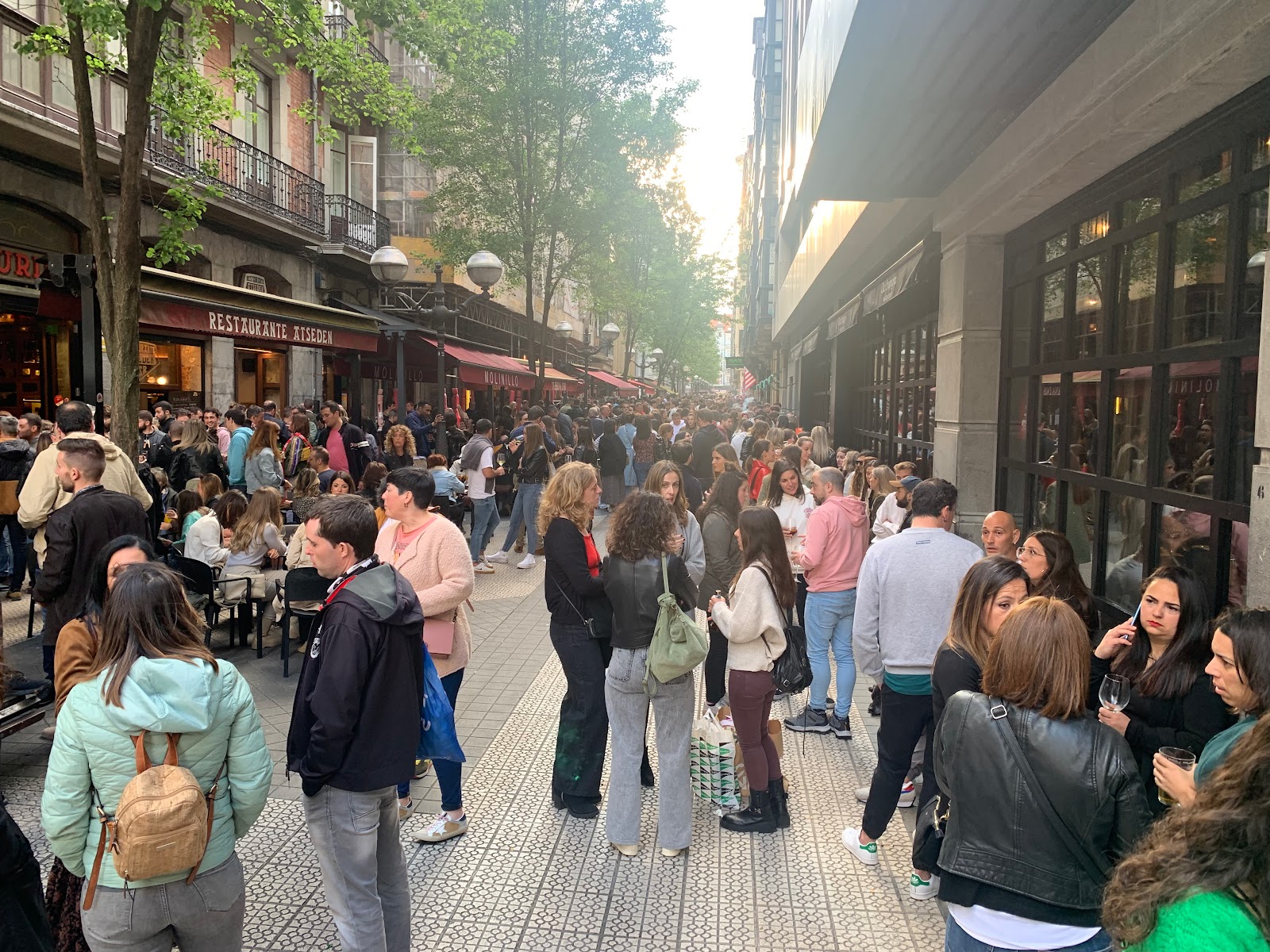
We started with a couple of days in Bilbao, which was remarkable for its street life.  On Saturday evening in particular, it seemed that everyone under 40 was out on the street drinking and eating with friends.


It's not just the streetside cafes and bars that were busy. Even the playgrounds were busy.


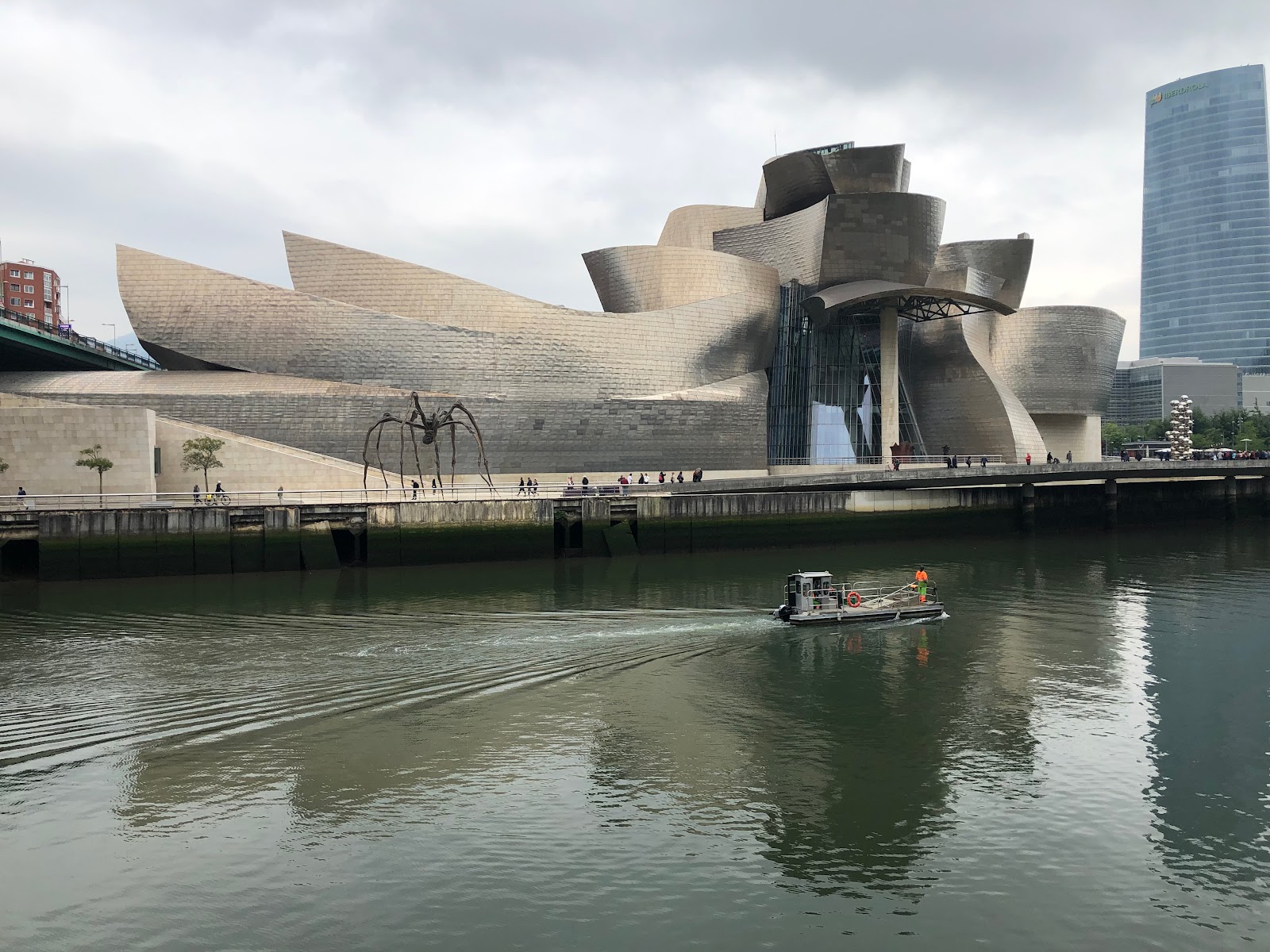
Of course the Guggenheim Museum is still a striking attraction on the edge of the river that runs through the middle of the city.


Arachnophobes might want to avoid the museum: there is quite an impressive spider next to it. 
 

There's also this interesting artwork not far from the hotel. I suppose it has many layers of symbolism, but it is also a monument that honors women who used to haul ships around the harbor via ropes, pretty much like this.


Juliet got a bit of exercise by running up and down the pedestrian stairway to one of the bridges.


Phil did a bike ride out in Basque Country.  He learned that the Basque name things by letting a cat walk on a keyboard. See?: 


One one of Phil's ride, he came across dozens of these 'deer crossing' signs that someone has modified by adding little wings:


One amusing thing: an accordion player set up outside our hotel and played for a few hours at a time each day. He wasn't bad...except that he only seemed to know three tunes. He played them over and over and over and over.  It was a bit much, but also kinda funny. (Click to play the video. Sound on, of course.)


After Bilbao we went west, to just outside the town of Arriondas, near the Picos de Europa.  We will post about that in our next post. 


Sunday, April 3, 2022

2022 Two weeks in Belize


We started the Belize vacation at Chan Chich Lodge, near the Guatemala border. The lodge is built in Plaza A of a Maya pyramid complex, how cool is that? An archaeological team from the Texas Tech University has been doing excavations. The site was abandoned sometime around 1000 A.D., when Mayan civilization went through a widespread collapse, probably due to a combination of drought and overpopulation. (The population of Belize at that time was probably well over a million; today it's around 420,000).  

Here we are standing -- with another guest, and a guide who is taking us on an archaeology/history tour -- in the center of the A-I mound on the map above, looking down on the lodge. 

Many of the pyramids have tunnels dug into them by looters looking for grave goods. According to our guide, many of the larger pyramids were built around smaller ones -- this one had about four layers -- and usually only the inner one was used as a burial; at some point the Maya stopped doing burials in pyramids. So the looters would have to dig all the way into the central part of the pyramid. By the way, these pyramids were intentionally buried, probably to keep the limestone rock from being eroded, presumably with the intent of returning when times improved. But then they didn't. 

Here's our room. It looks luxurious, and it was...except: no air conditioning! And we needed that mosquito netting. The daytime temperature was in the nineties and so was the relative humidity, so it wasn't the most physically comfortable vacation. But we loved it and are already talking about going back sometime, for reasons you'll see below. 


Although the archaeological stuff was cool, the main thing that drew us (and the other visitors) was the wildlife, including birds. Most of the other guests were hardcore birders. (I know some of you think that Juliet and I are hardcore birders. No. You have no idea.)  One of the guys in the photo below has been to Chan Chich four times...in the past year. Here we are on a bird walk with a guide, Luis, who I think is the best guide we've ever had anywhere. Not only did he know seemingly every bird and most of the trees and bushes by name, he also knew each bird's habits, scientific name, translation of the scientific name, why the bird had that name, etc., etc. And of course he was an absolutely amazing spotter. 

Below is a Rufous-Tailed Jacamar, one of many beautiful and/or interesting birds.

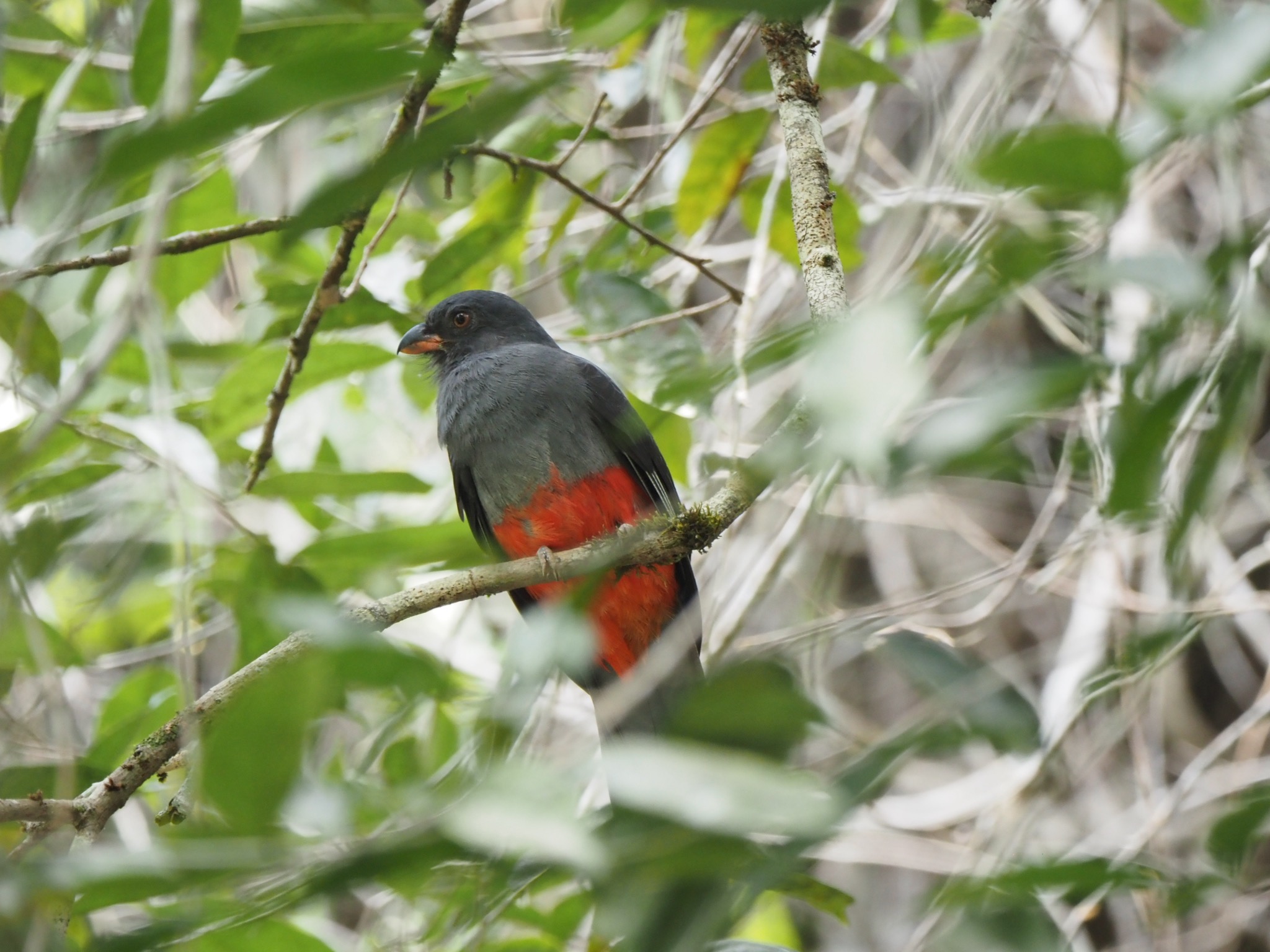
Below: a Slaty-Tailed Trogon. 

Below: Ocellated Turkey. This is why you should never design a bird while you're drunk. 

Below: Northern Potoo. Another crazy-looking bird. Check out that eye!


Below: Mottled Owl with prey (poor little fella). As you can tell from the lighting, we saw this and the potoo on nighttime drives. 

Below: a very young spider monkey. He was fascinated by us. 


Below: Mom, dad, and baby spider monkeys. Like the youngster above, the baby was fascinated by us and didn't take his eyes off us for forty minutes.


Below: although the other monkeys didn't mind us at all, this one took a dislike to us...especially to Juliet. He threw sticks at her and hit her with one!

If you've ever wondered why they're called "spider monkeys", wonder no more!

Just sitting comfortably, eating a fig and watching the sunset. As one does. 


In addition to spider monkeys, we also saw howler monkeys. Much bigger and heavier than the spider monkeys. They spend part of each day in howling contests with other bands of howler monkeys. They make a lot of noise. This one carefully peeled back some palm fronds so it could watch us. 


After a week in the jungle we flew and then boated to Isla Marisol, on Glover's Atoll, about an hour boat ride off the mainland. 

Just hours before we got there, some Cubans had "sailed" up in this ramshackle boat. They had been at sea for... I've forgotten, but it was some improbable number like 36 days. Incredible. 

Every day the resort staff came out and raked the plastic off the beach. It washed up in big bunches. 

We went diving twice a day, and also did a night dive. The dives ranged from good to excellent. Unfortunately the light down deep is too blue for our little GoPro camera to capture the colors as we perceived them, no matter how I adjust the white balance and such, so most of my photos are very disappointing. The one below is from very shallow water, snorkeling not scuba.  Looks great, right? But if you look closely you'll see that although the fans and sponges are doing great, almost all of the hard corals are dead; there are just two little spots of living coral in this photo. 


Really too bad the colors don't show up: all of those fans and corals should look colorful like in the first underwater photo above.  This was a pretty spectacular dive. 


Those little tiny flecks around the top of this coral are not photographic compression artifacts, they're tiny little fish fry. 


Here are some corals that are doing OK, along with some Foureye Butterflyfish.