Sunday, April 3, 2022

2022 Two weeks in Belize


We started the Belize vacation at Chan Chich Lodge, near the Guatemala border. The lodge is built in Plaza A of a Maya pyramid complex, how cool is that? An archaeological team from the Texas Tech University has been doing excavations. The site was abandoned sometime around 1000 A.D., when Mayan civilization went through a widespread collapse, probably due to a combination of drought and overpopulation. (The population of Belize at that time was probably well over a million; today it's around 420,000).  

Here we are standing -- with another guest, and a guide who is taking us on an archaeology/history tour -- in the center of the A-I mound on the map above, looking down on the lodge. 

Many of the pyramids have tunnels dug into them by looters looking for grave goods. According to our guide, many of the larger pyramids were built around smaller ones -- this one had about four layers -- and usually only the inner one was used as a burial; at some point the Maya stopped doing burials in pyramids. So the looters would have to dig all the way into the central part of the pyramid. By the way, these pyramids were intentionally buried, probably to keep the limestone rock from being eroded, presumably with the intent of returning when times improved. But then they didn't. 

Here's our room. It looks luxurious, and it was...except: no air conditioning! And we needed that mosquito netting. The daytime temperature was in the nineties and so was the relative humidity, so it wasn't the most physically comfortable vacation. But we loved it and are already talking about going back sometime, for reasons you'll see below. 


Although the archaeological stuff was cool, the main thing that drew us (and the other visitors) was the wildlife, including birds. Most of the other guests were hardcore birders. (I know some of you think that Juliet and I are hardcore birders. No. You have no idea.)  One of the guys in the photo below has been to Chan Chich four times...in the past year. Here we are on a bird walk with a guide, Luis, who I think is the best guide we've ever had anywhere. Not only did he know seemingly every bird and most of the trees and bushes by name, he also knew each bird's habits, scientific name, translation of the scientific name, why the bird had that name, etc., etc. And of course he was an absolutely amazing spotter. 

Below is a Rufous-Tailed Jacamar, one of many beautiful and/or interesting birds.

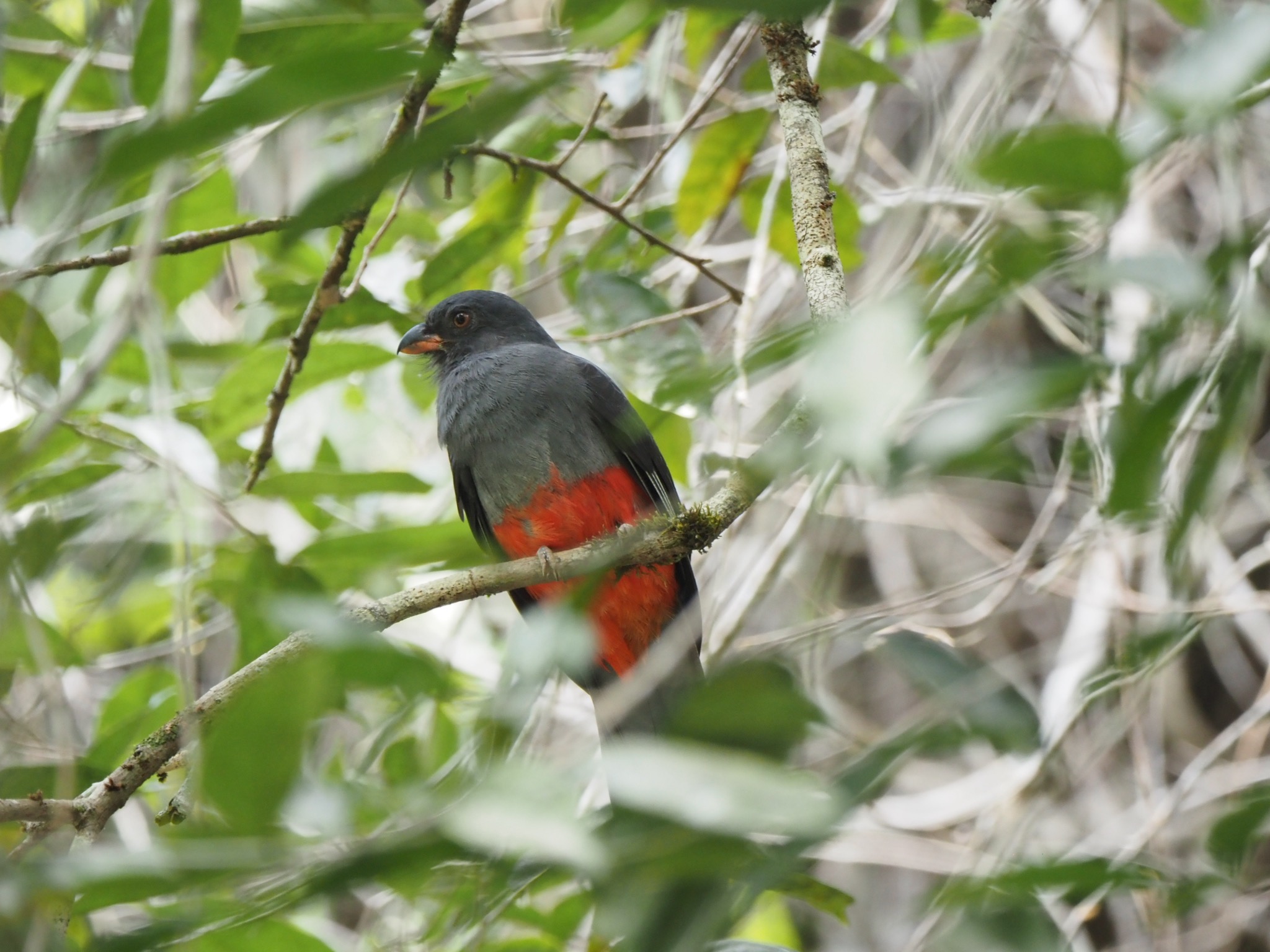
Below: a Slaty-Tailed Trogon. 
Below: Ocellated Turkey. This is why you should never design a bird while you're drunk. 

Below: Northern Potoo. Another crazy-looking bird. Check out that eye!


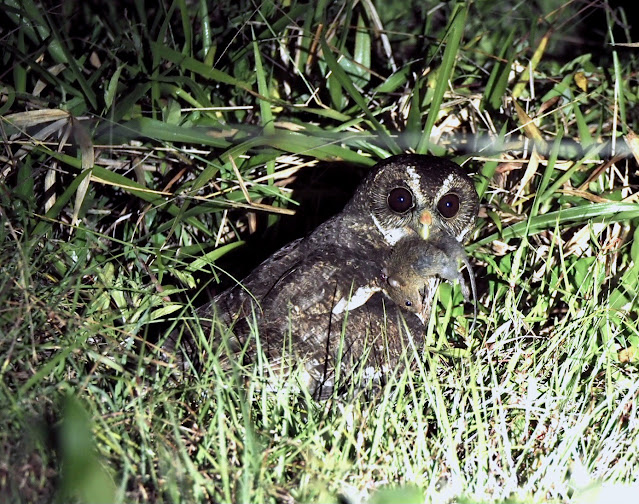
Below: Mottled Owl with prey (poor little fella). As you can tell from the lighting, we saw this and the potoo on nighttime drives. 
Below: a very young spider monkey. He was fascinated by us. 


Below: Mom, dad, and baby spider monkeys. Like the youngster above, the baby was fascinated by us and didn't take his eyes off us for forty minutes.


Below: although the other monkeys didn't mind us at all, this one took a dislike to us...especially to Juliet. He threw sticks at her and hit her with one!

If you've ever wondered why they're called "spider monkeys", wonder no more!

Just sitting comfortably, eating a fig and watching the sunset. As one does. 


In addition to spider monkeys, we also saw howler monkeys. Much bigger and heavier than the spider monkeys. They spend part of each day in howling contests with other bands of howler monkeys. They make a lot of noise. This one carefully peeled back some palm fronds so it could watch us. 


After a week in the jungle we flew and then boated to Isla Marisol, on Glover's Atoll, about an hour boat ride off the mainland. 

Just hours before we got there, some Cubans had "sailed" up in this ramshackle boat. They had been at sea for... I've forgotten, but it was some improbable number like 36 days. Incredible. 

Every day the resort staff came out and raked the plastic off the beach. It washed up in big bunches. 

We went diving twice a day, and also did a night dive. The dives ranged from good to excellent. Unfortunately the light down deep is too blue for our little GoPro camera to capture the colors as we perceived them, no matter how I adjust the white balance and such, so most of my photos are very disappointing. The one below is from very shallow water, snorkeling not scuba.  Looks great, right? But if you look closely you'll see that although the fans and sponges are doing great, almost all of the hard corals are dead; there are just two little spots of living coral in this photo. 


Really too bad the colors don't show up: all of those fans and corals should look colorful like in the first underwater photo above.  This was a pretty spectacular dive. 


Those little tiny flecks around the top of this coral are not photographic compression artifacts, they're tiny little fish fry. 


Here are some corals that are doing OK, along with some Foureye Butterflyfish. 


Wednesday, February 1, 2017

Cuba, post #2, written a week after our return.

Time is flying by, so rather than wait until we have time to write the perfect joint post, I (Phil) am just going to go ahead and get something up here. I know Juliet shared some of my impressions, but maybe not all of them and I don't want to speak for her, so I'll just speak for myself here. Maybe Juliet will come through later and edit. 

I’m not sure what I expected Cuba to be like, but I can say it wasn’t like I expected. 

For one thing, Havana had way more tourists than I would have expected, if I had thought about it in advance. “Habana Viejo” = Old Havana was swarming with thousands of tourists, many of them from a giant cruise ship. Americans, Canadians (sure, I know Canadians are Americans too, but you know what I mean…when I say Americans I mean _real_ Americans), Germans, French seemed to be the most common, perhaps in that order. 

Any place in the US with that concentration of tourists, or anything remotely like it, would be maintained in good condition, but Old Havana is literally falling to pieces. It seems that the model is to do nearly no maintenance on most buildings, year after year, but then every now and then to do a complete restoration on one of them. There are 100- or 200-year-old buildings in which the lower floor and half of the upper are uninhabitable, with the internal walls collapsing and water leaking into one corner, while the other half of the upstairs has someone living there. Such buildings exist but are not common; much more common is buildings that are merely poorly maintained, inside and out..which you can see because  you walk down the street, turn your head, and you’re looking into someone’s living room ten feet away. I know from reading a book of travelers’ letters spanning 500 years that Havana has always had a culture of simply leaving the downstairs windows and doors open, such that passersby can look into the apartment, and this is still true, evidently.

Below is a photo from a typical Old Havana street. This one is not one of the main tourist streets, so most of the people pictured are locals. The capitol building is in the distance. The street is open to cars, but it’s rare to see one on one of these little streets: most of the locals can’t afford a taxi and certainly not a car, and tourist taxis mostly patrol the perimeter rather than getting involved with slowly picking their way through the pedestrians and pedi-cabs.

Pedi-cabs are used by tourists but also by locals. Note the American flag. 


There really are lots of ancient American cars around, mostly being used as taxis. But there are also more modern cars. The modern taxis, such as the yellow cab in the photo below, are owned by the government and leased to the driver.  Some of these have meters (maybe all of them) but although we took both old-style and modern cabs a dozen times, the meter was never used. We would negotiate the price before getting in, although there did seem to be fairly standard pricing at least for the trips we took. 
Taxis in Havana, on the border between Old Havana and Central Havana


Our few days in Havana included: visit to Independence Square (or maybe it’s Revolutionary Square or something, I forget); I got a shave; I lost a game of chess against a guy in a park; we went to a performance of The Nutcracker (very good, especially the second act) that was attended by the legendary dancer Alicia Alonso, now in her nineties; we ate at a couple of good restaurants; we went to a small ceramics museum (which is in the heart of Old Havana, cost only $3 admission, and was quite good... but we were the only visitors in the half hour or so that we were there! People are missing out!).

After that we took a long (5-hour) taxi drive to the western end of the island — a bargain at only $100 or so, prearranged by our Cuban bird guide/trip organizer who had to do a lot of shopping around to get that rate.  We went to a dive center called Maria La Gorda (= Maria the fat woman). We each did five dives, only about 50 minutes per dive (Juliet and I both climbed back in the boat with about half of our air each time). Previously, the best reef diving we had done was in Fiji, and it was awesome, but this was possibly even better.  We didn't see any big stuff: no sharks or really big fish, the biggest things we saw were some 3- or 4-foot barracuda -- but lots of small fish. What blew us away, though, were the variety and health of the corals. The reef is just incredibly healthy. It’s a national park that supposedly has no fishing (but actually the dive center has a boat that goes out daily for line fishing…but still, one boat with a few fishing lines, on miles and miles of undeveloped area….it’s _nearly_ no fishing).  No significant pollution source for hundreds of miles, either. We may go back someday just for a dive vacation, back to Maria La Gorda and/or a live-aboard boat on a reef south of the central part of Cuba.

Mostly the Maria La Gorda stay was great…except that for one 12-hour period I was violently ill with food poisoning. Started about midnight, was a lot better by noon, and I was recovered enough to do a 3pm dive. Pretty horrible 12 hours though. Incredible how quickly it came and went. Other than that, neither of us had any problem with the food on the whole trip. Except for a few nice restaurants in Havana, the menu was rather monotonous, everywhere in the country, but palatable and sometimes pretty good. We mostly were staying and eating at “hostals”, which are private residences in which some rooms are rented out…essentially a B&B.

Typically there would be Moros y Christianos = Moors and Christians = black beans and rice (black and white, get it?); tomatoes; cabbage and possibly lettuce; chicken or beef or pork or a few times fish; bread; and cheese.  Juliet stuck to her vegetarian diet, whereas I ate some chicken every few days, and a little bit of beef a couple of times. 

.According to one of our guides, most farming in Cuba is done on government-owned farms in which the farmer is required to give a fixed amount of production to the government (this is the basis for the ration) but they’re allowed to sell any excess. 

Much of the agriculture is done with horses or oxen, or by hand, and a lot of transportation is by horse cart. If the Amish can do it, so can the Cubans

I assume these are farmers selling their excess production in this very nice market.


The country was a lot less socialist than I expected. We talked with our bird guide and a second Cuban who was basically a driver, and had very brief discussions with a few other Cubans, who told us this: everyone gets a ration book which they can use to get rice, beans, and a few other staples every month. The government also provides housing for people who don’t have it.  It would be possible to live on just the ration, maybe, but the people we spoke to don’t know anyone who does that. “Maybe some people.” Just about everyone has some source of income.  Education is free, as is health care.  There are government jobs, but it’s not like everyone or even a lot of people work for the government. The driver, for example, had recently quit his government job as a veterinarian…which paid 16 cuc per month.  

A “cuc” is a “convertible” peso, i.e. one that can be exchanged for dollars. Theoretically 1 cuc is worth very close to $1 US, but there is a fee to change money that seems to be inescapable, so it costs something like $1.15 to buy a cuc.  The cuc (pronounced “kook”)  is a holdover from years ago, when there was much more government control over the economy: at one time it was illegal for ordinary Cubans to own cucs, and foreigners couldn’t own regular pesos…something like that. The system seems almost completely irrelevant now. There is a fixed exchange rate of 25 pesos per cuc, and Cubans use either. There are a few cases in which prices are different for Cubans and foreigners, such as some museum admissions (the ceramics museum was 3 cuc for us, and 3 pesos for a Cuban, so 25x more expensive for us) but except for those rare cases Cubans pay the same prices as foreigners. This surprised us because many of the prices were fairly high, like 2 cuc for a big (1.5-liter) bottle of water, but our guide assured us that if a Cuban wanted to buy one, they, too, would have to pay 2 cuc or 50 pesos.  Which means a veterinarian getting paid 16 cuc per month is getting practically nothing, roughly $0.50 per DAY (in addition to the government ration). Unsurprisingly, everyone who has any space at all has a garden where they grow tomatoes and lettuce etc., and a couple of chickens scratching around. But also — and this was a surprise — there is a huge black market that the government doesn’t seem to try to suppress. We hired a guide in Havana for half a day, and she said literally everything she owns was bought on the black market: her clothes, her cell phone, her cell phone minutes, etc. 

Next post will probably discuss the two weeks we spent birding all through central Cuba.


Friday, January 20, 2017


Cuba...the first few days of our trip 


We hired a guide for half a day in Havana. here she and Juliet are walking down a typical street slightly off the main tourist area. Note the very narrow sidewalks, which have been mentioned by visitors to the city since at least the early 1800s (we bought a book with essays by travelers to Cuba through the years).


A building with a tree growing out of it is not a happy building. "Old Havana", which has buildings as old as the 1600s, is decaying faster than it is being restored. You'll see buildings that are falling apart (like this one) that still have occupied apartments.  


When a building does get restored, the results can be spectacular. This is the National Theater, where we saw a performance of "Cascanueces",  i.e. "the Cracker of Nuts." 


Alicia Alonso, the great Cuban ballerina who is now in 96 years old, came to the performance. The second act in particular was very colorful and the men were notably athletic. Phil said "it's not fair that the Nutcracker Prince is allowed to kill the Rat King with his sword, because the Rat King was kicking his ass in their dance-off."


Phil lost a chess game to this guy in the park. Phil says "I gave up a knight for two pawns and a strong attack, and everything was going great until I blundered a piece."


Phil also got a shave. The barber left him with long Cuban sideburns. Suave!


We also visited La Floridita, where Ernest Hemingway used to drink daiquiris. The place was stuffed with tourists like us, all taking photos of the jazz band crammed into one end of the room.


We had a few days in Havana and a few days scuba diving in a national park at the extreme east end of the country, then joined six other tourists and two guides for a birding tour of the central part of the country. Here everyone is looking at a pygmy owl.


This is the Bee Hummingbird, the smallest bird in the world. Juliet took the photo. If you're looking at this on a computer instead of a phone, this is larger than actual size: the bird is the size of a child's thumb, and weighs less than two M&Ms. 


Thursday, August 6, 2015

A ride through the French countryside.

For the third consecutive year, I (Phil) have come to Europe to bike in the mountains with my friend Hal. In 2013 we did a Thompson Bike Tours trip through the Pyrenees (border of France and Spain). In 2014 we did another Thompson trip, in the Dolomites (Italy near the Austrian border) and the Italian Alps. This year, we are doing a "self-guided" trip in the French Alps, with two friends, Tom and Ted.

My trip started in Geneva, where I arrived a day earlier than the rest of the crew. I rented a bike, checked into my hotel, and then took the bus downtown to Lake Geneva to stroll around for the evening.
There was a big festival (or combination of festivals) lakeside, including some displays about local agriculture but mostly just lots of food and drink booths.

Tens of thousands of people were out enjoying the evening.
My friends' flight was delayed the next day, so I did a morning ride. Just five minutes ride from the Geneva airport and I was riding on a nicely paved bike route through farm fields. The sunflowers are a bit sad because it was raining. I biked out to the mountains behind the clouds in the background, and got in some nice climbing.


I will spare you photos of all of the mountains we climbed, but here's one of them: the mighty Galibier. It just goes on for miles and miles, topping out at 8600 feet. As you can see, it's rather barren at the summit, but just a few hundred feet below there are alpine meadows dotted with wildflowers.
I love this jersey, and I thought I'd get lots of compliments on it (or at least amused looks) here in France. Nope. One waitress asked "don't you know what that means? And you wear it anyway?"

At the base of Galibier, there's a town has a make-a-sculpture-out-of-straw festival. Here's one of my favorites. 
In addition to biking, we've been doing two other things: eating and sleeping. This was on the wall of a Turkish restaurant we liked. It appears to be a beaver praying to a butterfly.


This cool-looking climb is called "les lacets de Montvernier," and it was climbed on this year's Tour de France. It's not actually a hard climb, just a few kilometers at about 8% grade...a midget compared to the big climbs. Looks great, though.

At the top of Les Lacets, there's a beautiful plateau, including this lovely view.

And here's the crew: Hal, Ted, and Tom. 

And here we area again, at the top of Col de la Madeleine. This was a beautiful, difficult climb through forests and then above the tree line. The weather looks forbidding but was actually quite nice: cool and overcast beats hot and sunny when you're climbing.